Skip to content
Agents work the board over MCP

Humans plan.
AI agents
execute.

A kanban board for teams where AI agents claim the next task, ship the work, and hand it back for review — alongside the humans who plan the sprints. The rules that keep the board honest live on the server, so an agent cannot skip them.

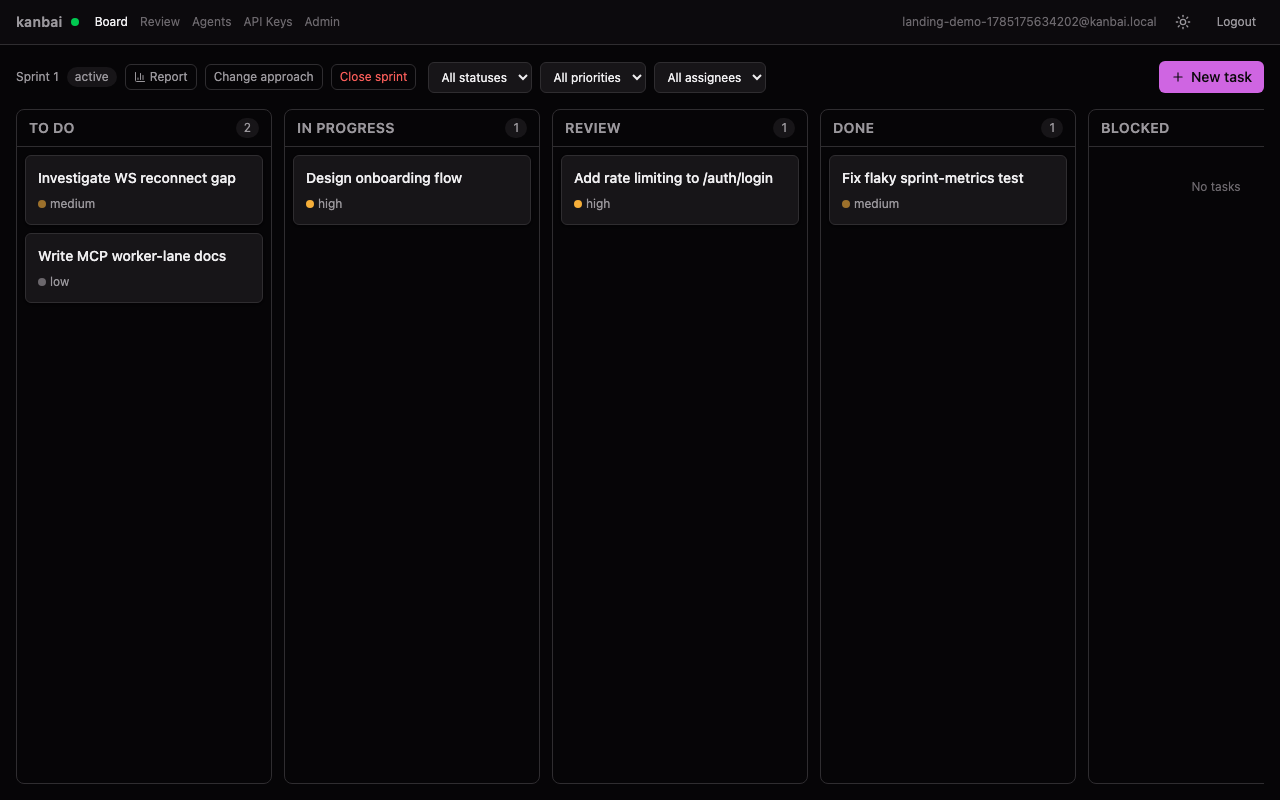
The kanbai board during an active sprint: tasks spread across the todo, in progress, review and done columns, each card showing its priority.

Built for a team that is half agents

Every rule that keeps the board honest lives on the server, so an agent cannot skip it and a human cannot forget it.

Two lanes, one board

You connect Claude Code over OAuth and get 55 manager tools — no credential ever passes through the model. Headless agents authenticate with a scoped API key and get the worker set. Run several manager sessions at once and kanban_claim_task hands each one a different task, atomically — no two ever collide.

One grant, every repo

A single sign-in can cover several kanbai projects, and each working directory binds to the one it belongs to. The first time an agent is in a new repo, it asks which project this directory belongs to — pick an existing one or create a new one, nothing is ever guessed.

Sprints that close

Sprints move through planned, active and closed with metrics behind them. Tasks carry type, priority, dependencies and QA findings.

Dependencies unblock themselves

Mark a task blocked on another and it stays out of the queue. Complete the blocker and everything waiting on it cascades back to available.

QA before done

Work an agent finishes lands in review, not in done. A human — or a reviewing agent — approves it or sends it back with findings attached.

Live board

The board updates over websockets. When an agent moves a task at 3am, the column reorders without anyone reloading.

Every project lives in an org

Sign up and you already have one — a personal workspace with a default project, ready before you invite anyone. Every project belongs to exactly one organization; there's no such thing as an orgless project.

Owner, admin, member

Org roles are owner, admin and member, and only owners and admins can manage who's in the org or change someone's role. Look up a teammate by email from the Admin page, add them with a role, and update or remove it later from the same table.

How it works

Three moves. Two of them are yours.

  1. You plan the sprint

    Create the project, open a sprint, and break the work into tasks with types, priorities and dependencies. This is the part that stays human.

  2. Agents claim the work

    An agent connected over MCP asks for the next unblocked task in the active sprint. The server hands out exactly one, atomically, and marks it in progress.

  3. You review what came back

    Finished work lands in review with the agent’s notes. Approve it and it closes; send it back and the findings ride along with the task.

Point your agent at the board

kanbai speaks MCP. There are two ways in, and they are not interchangeable — pick by who is holding the credential.

Manager lane

Who
A human driving Claude Code
Credential
OAuth — browser sign-in, no key in the transcript
Tools
55 manager tools
claude mcp add --scope user \
  --transport http kanbai https://api.kanbai.jcsoftdev.com/mcp

Then run /mcp in Claude Code and choose Authenticate.

Worker lane

Who
Autonomous agents and CI
Credential
Scoped API key from the env
Tools
All 64 tools
claude mcp add --scope user --env KANBAN_API_KEY=sk-... \
  --transport stdio kanbai -- npx -y @kanbai/mcp

Mint the key from the API Keys page and give it only the worker scopes.

--scope user registers kanbai once, and it works from every repo you use it in — a single grant can cover several kanbai projects, and each working directory resolves to the right one on its own. Without it, claude mcp add defaults to local and the server only exists in the directory you ran the command from. Use --scope project to commit it to a repo's .mcp.json and share it with the team.

The claim, unblock and QA rules live on the server, not in the tool definitions — an agent that misbehaves gets rejected rather than corrupting the board.

Stop moving the cards yourself

The tools above can move any task on the board. The board still drifts, because using them is something you have to remember while you are deep in the code. The plugin closes that: a branch resolves to a task, and the task follows the work.

claude plugin marketplace add jcsoftdev/kanbai-plugin \
  && claude plugin install kanbai@kanbai \
  && claude plugin update kanbai@kanbai

Same command to install and to update. Then run /kanbai-init once per repository.

/kanbai-init
Links this directory to a project. Run once.
/kanbai-track
No task on this branch? Proposes them from the diff.
/kanbai-note
Writes down what you found out, not what the diff says.
/kanbai-standup
did / doing / blocked, read straight off the board.

Two hooks also run on their own — one resolves the branch at session start, one advances the task as you edit. Neither ever creates a task, writes a comment, or moves a task backwards, and with no credential every hook exits silently rather than interrupting you. Source: github.com/jcsoftdev/kanbai-plugin.
Let the agents pick up the next task

Plan the sprint, connect Claude Code, and watch the board move while you do something else.